CASE FILE 10/13CLASS: SAMPLE BUILDDATA: REALISTIC, NOT CLIENTTYPE: Data cleaning & migration
Sample build: realistic data, built to show how I'd handle this work. Not client work.
Sample buildData cleaning & migration
Contact data cleanup: three messy exports to one clean CRM import
1,500 messy contact rows reduced to 1,234 clean records, with every change logged
- 1,500rows in
- 1,234clean contacts out
- 9,439changes logged
- 10/10validation checks pass
01Summary
- 1,500 contact rows from 3 sources are cleaned into 1,234 import-ready records.
- 240 duplicates are merged by rule and 9,439 changes are logged cell by cell.
- 10 of 10 validation checks pass, and the row count reconciles to the input.
240 duplicates are merged by rule and 9,439 changes are logged cell by cell.
Key point, computed from the sample files
02The scenario
In this scenario the same person appears in several lists with different spellings, phone formats and state names, and junk rows and test entries are mixed in. Importing as-is would create duplicates and bad data in the CRM.
Source: sample files
03Issues in the data
Source: sample files
04How I approached it
- A cleaning script that standardises names, phones (+61 format), states, postcodes, company suffixes and lifecycle stages.
- Duplicate matching with three rules, merging 240 groups while keeping same-name people at different companies apart.
- A change log with the before and after value and the rule used for every change.
- A validation report workbook with summary, checks, merge log, exceptions and field mapping.
Source: my design and the sample files
05How this applies to your business
- Assess and designMap the current process, size the gaps from your own data, agree the design and a written scope.
- Build and testBuild in your own tools with the checks built in, then run real cases end to end.
- Document and hand overSOPs, a walkthrough and a handover, so your team runs it without me.
| Activity | Business owner | Specialist (me) | Your team |
|---|---|---|---|
| Agree field rules | A | R | C |
| Run the cleanup | I | R | I |
| Review merges | A | C | R |
| Import to the CRM | A | C | R |
Source: sample plan
06Controls and checks
| Check | What it catches | Status |
|---|---|---|
| Rows reconcile: output + duplicates merged + junk removed = input | Listed on the Checks tab | PASS |
| No duplicate emails in the import | Listed on the Checks tab | PASS |
| Every contact has first + last name | Listed on the Checks tab | PASS |
| All emails contain one @ | Listed on the Checks tab | PASS |
| All phone numbers start +61 | Listed on the Checks tab | PASS |
| All states are standard abbreviations | Listed on the Checks tab | PASS |
| All postcodes are 4 characters | Listed on the Checks tab | PASS |
| All lifecycle stages valid HubSpot values | Listed on the Checks tab | PASS |
| Company names end in 'Pty Ltd' | Listed on the Checks tab | PASS |
| Every merged record traced in Merge Log | Listed on the Checks tab | PASS |
Source: sample files (Checks / Controls tab, test output or run log)
07What the files show
- 1,500rows in
- 1,234clean contacts out
- 9,439changes logged
- 10/10validation checks pass
Source: sample files, measured by script. Sample data, not a client result.
- Rows reconcile: 1,234 out plus 266 removed (duplicates merged and junk rows) equals 1,500 in.
- 0 duplicate emails remain in the import; 9 contacts have no email and are kept.
- 1,234 of 1,234 phone fields are in +61 format or blank.
- 13 distinct cleaning rules appear in the change log.
08Risks and how the build handles them
| Risk | Mitigation built in |
|---|---|
| Two different people merged | Merge only on documented match rules; merge log shows every pair |
| Data lost in cleaning | Rows out + merged + removed = rows in |
| Bad values reach the CRM | Validation checks run before import |
Source: sample design
09Appendix: files
A. Screenshots of the deliverable
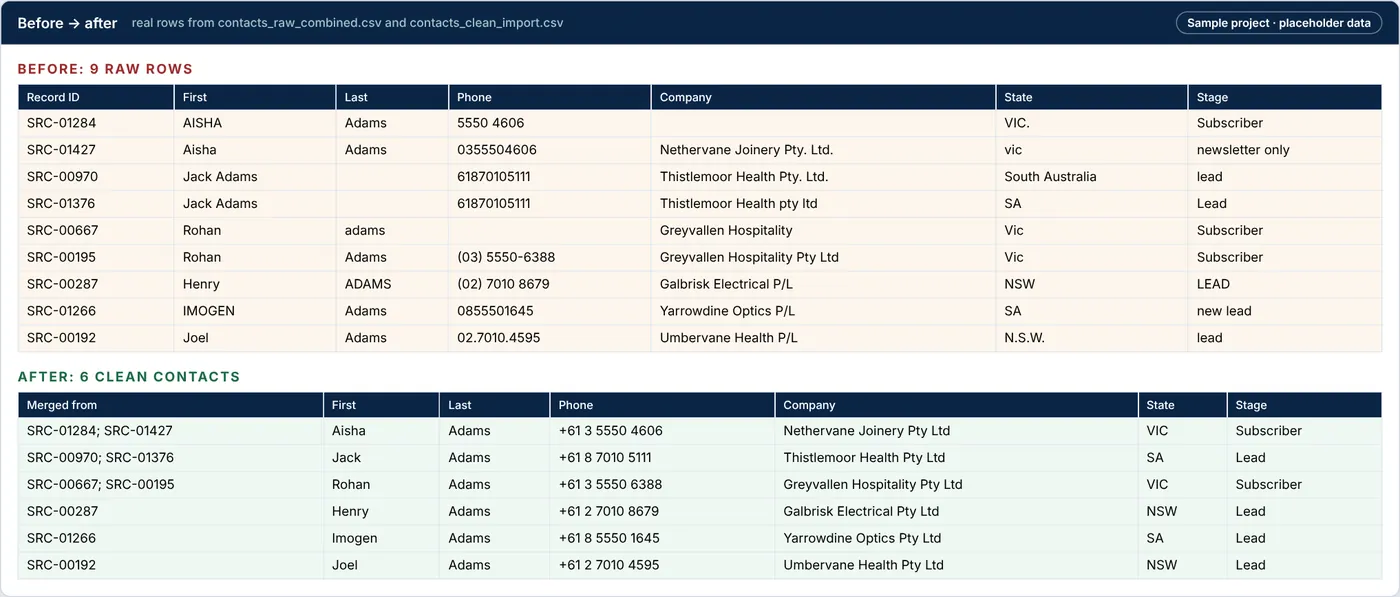
Exhibit 8: Before and after: raw contact rows with mixed phone formats, casing and state names, and the merged clean contacts they became
Source: sample files
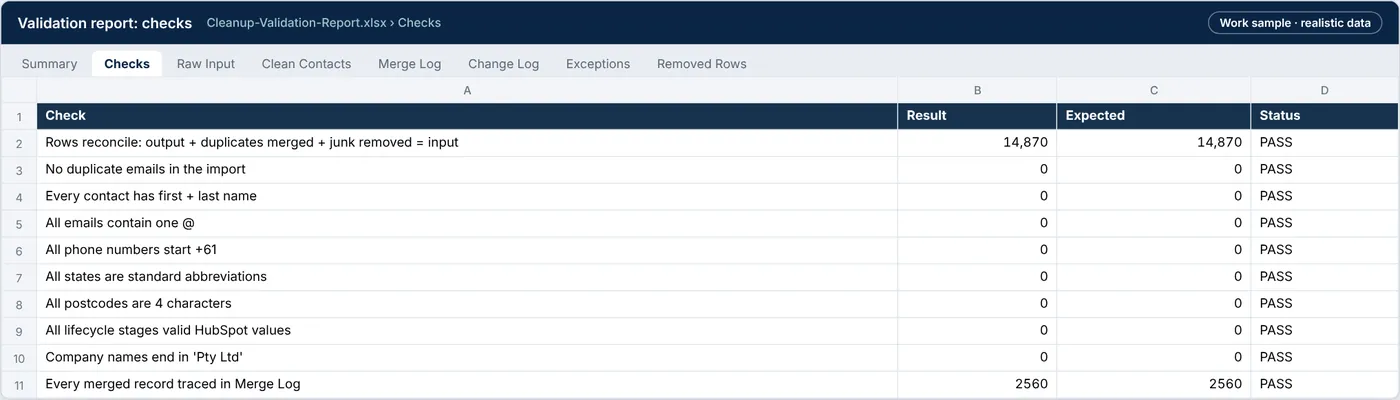
Exhibit 9: Validation report checks tab: row reconciliation and nine data quality checks, all passing
Source: sample files
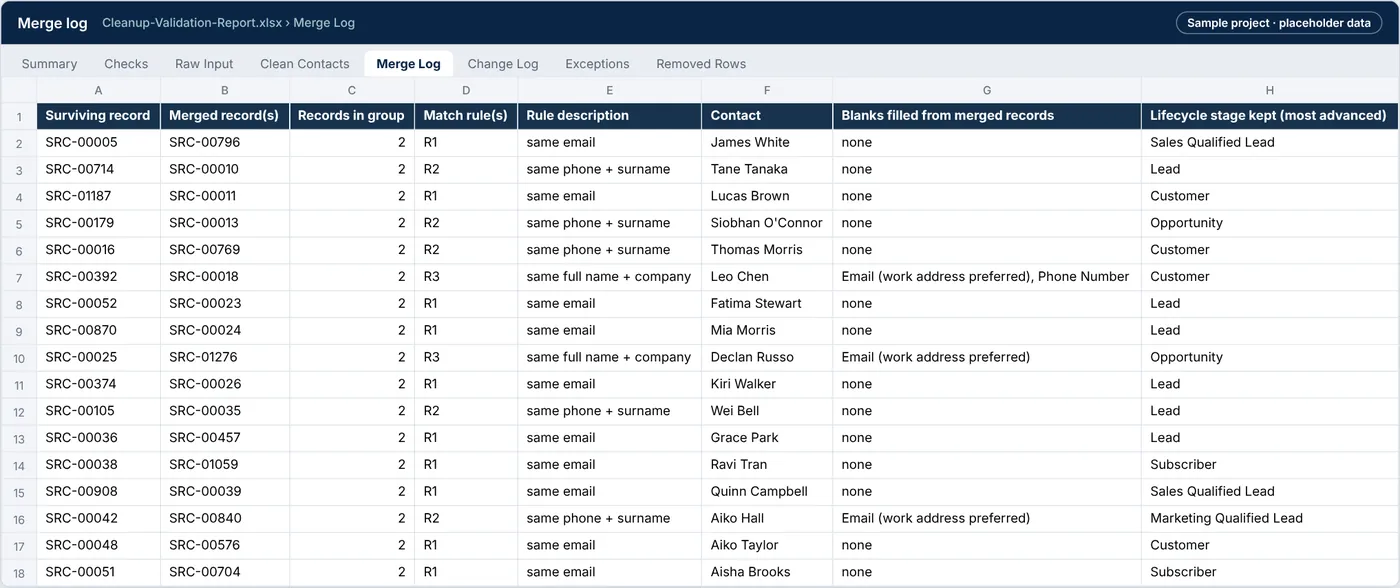
Exhibit 10: Merge log tab showing which raw records were merged and by which match rule
Source: sample files
def clean_phone(v, state, rid, field):
    d = re.sub(r"\D", "", v or "")
    if not d: return ""
    if d.startswith("61"): d = "0" + d[2:]
    if len(d) == 8 and state in AREA:
        d = "0" + AREA[state] + d; exceptions.append([rid, field, v, "Area code missing: inferred 0" + AREA[state] + " from state " + state, "Info"])
    if len(d) != 10 or not d.startswith("0"):
        exceptions.append([rid, field, v, "Phone number could not be parsed: cleared", "Fix at source"]); return ""
    return f"+61 {d[1:4]} {d[4:7]} {d[7:]}" if d.startswith("04") else f"+61 {d[1]} {d[2:6]} {d[6:]}"
Source: clean_contacts.py
B. Downloadable files
| File | What it is | Size |
|---|---|---|
| contacts_raw_combined.csv | Input: three messy contact lists combined (before) | 250.3 KB |
| contacts_clean_import.csv | Output: clean, de-duplicated import file (after) | 231.3 KB |
| change_log.csv | Every field change with before, after and rule | 690.5 KB |
| Cleanup-Validation-Report.xlsx | Validation report: summary, checks, merge log, exceptions, field mapping | 598 KB |
| clean_contacts.py | The cleaning script (Python, pandas) | 10.7 KB |
Sample build: realistic data, built to show how I'd handle this work. Names are placeholders and no client data is used.
Have a similar problem in your business?
Hire me on Upwork (opens in a new tab)